
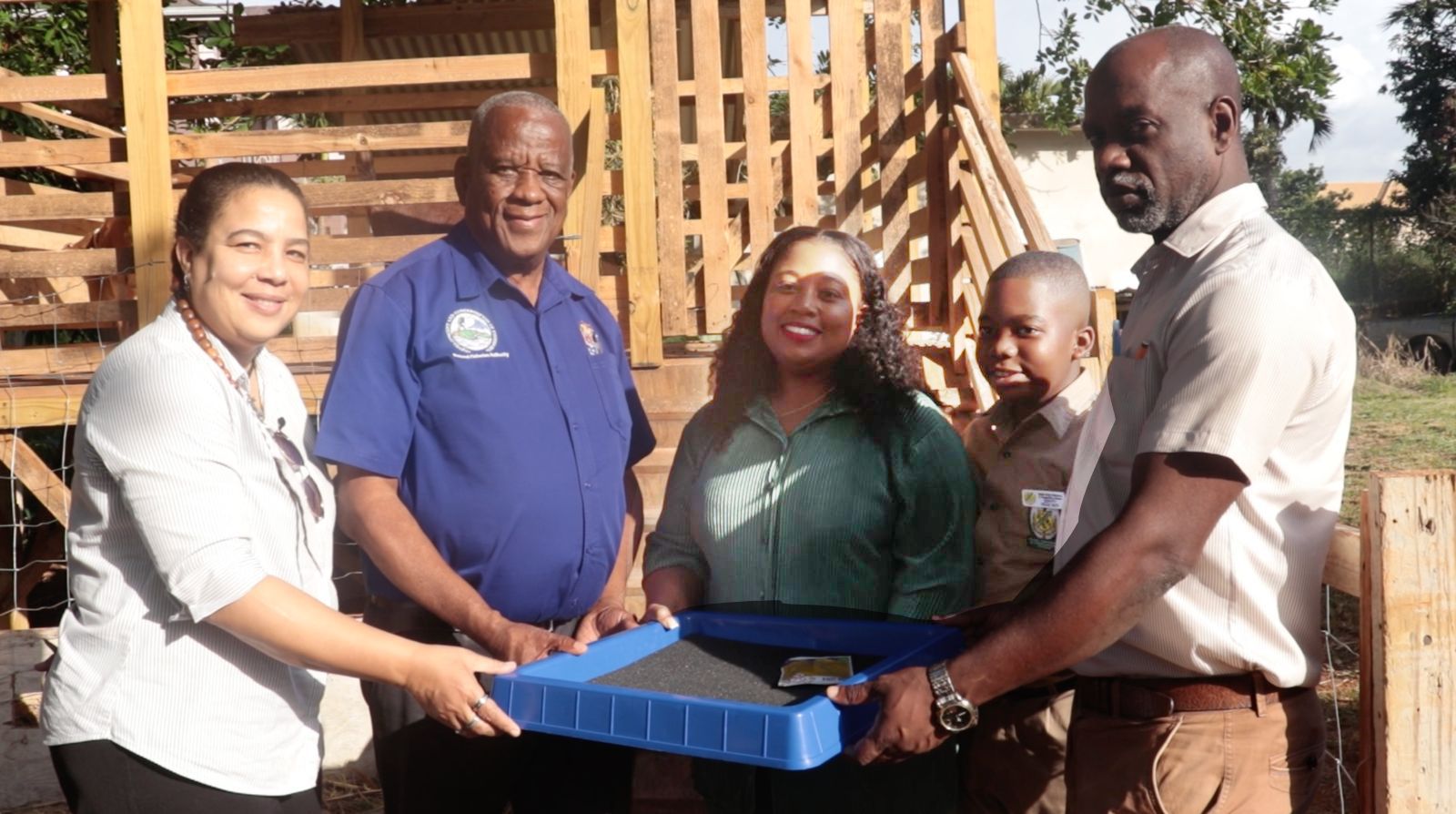
RADA Strengthens Food Security with Small Ruminant Handover at Manchester High School
The Rural Agricultural Development Authority (RADA) continues to strengthen Jamaica’s food security and youth participation in agriculture with the handing over of goats and goat houses, under the Small Ruminant Programme, implemented within the parish of Manchester.
The initiative comes at a critical time for Jamaica’s livestock sector, as the small ruminant industry, particularly goat farming, is a vital component of Jamaica’s agricultural landscape.
RADA and its partners are implementing the Small Ruminant Enterprise Development Programme for Jamaica’s Young Farmers, which focuses on increasing domestic goat meat production while equipping young people with the skills and resources needed to succeed in the sector.
Franklyn Witter, State Minister in the Ministry of Agriculture, Fisheries and Mining during a recent presentation of vertical hydroponics farming towers to students at the Manchester High School and Holmwood Technical High School, also did a handover of goats and goat houses under RADA’s Small Ruminant Programme.
“It is about empowerment, resilience, and national development. By investing in our schools, we are shaping future farmers. We are supporting small ruminant producers, and we are reducing imports, creating jobs, and strengthening rural communities. As we work together, we are moving Jamaica closer to food security and agricultural self-sufficiency,” he said.
Southern parishes such as Manchester, Clarendon, and St. Elizabeth offer ideal conditions for small ruminant production. These areas feature plains with low and variable rainfall, dry vegetation, and natural pastures well suited to goats and sheep.
Additionally, the development of Small Ruminant Agro-Parks in Middlesex, utilizing lands previously mined for bauxite, presents significant opportunities for increased production and productivity. When managed under strictly organic conditions, small ruminant farming also opens doors to profitability within the growing organic and health-conscious market segment.
“Young farmers are central to the future of Jamaica’s agriculture. Across rural communities, many young people are eager to pursue farming as a business but face barriers such as limited access to capital, technical knowledge, and mentorship,” Witter said.
This programme seeks to bridge that gap by providing starter units, including goats, housing, and feed, alongside capacity-building support in animal husbandry, farm management, business skills, and sustainable farming practices.
During the handing-over ceremony Garnet Edmondson, Chief Executive Officer at RADA, said these initiatives represent our commitment to food security, youth engagement, innovation, and sustainable livestock development.
“We are serious about reducing food imports and strengthening rural livelihoods, and small ruminant farming, goats and sheep, is central to the strategy,” Edmondson said.
“By targeting youth, the programme aims to develop a new generation of agricultural entrepreneurs who can increase productivity, adopt innovative practices, and contribute meaningfully to national food security. Beyond economic benefits, the initiative promotes empowerment and ownership, ensuring that young farmers are positioned to build resilient and sustainable livelihoods,” he added.
The Small Ruminant Enterprise Development Programme is a comprehensive one-year initiative targeting 50 young farmers between the ages of 18 and 35 across five parishes, Manchester, St. Elizabeth, St. Mary, Clarendon, and St. Catherine.
Each participant receives two goats (with an 80 per cent female and 20 per cent male ratio) and pre-assembled, durable goat housing, along with ongoing technical support.
Implementation is being carried out in partnership with the Ministry of Agriculture and Fisheries and RADA, with strong emphasis on monitoring and evaluation. Regular assessments focus on farm progress, goat health, and income generation to ensure programme objectives are met.
So far, 40 farmers have been enrolled and are at various stages of implementation. Of the 24 completed goat houses, 17 farmers have already received their starter units, representing 34 goats distributed. An additional seven completed houses, four in Clarendon and three in St. Catherine, are awaiting animal distribution.
National objectives for the sector include increasing the goat population to 2.5 million, improving marketing through value-added products such as specialized cuts, leather, milk, and cheese, expanding exports to the region and Central America, and attracting new entrants into the industry.